


2023 Marsannay Rouge “Les Longeroies”
René Bouvier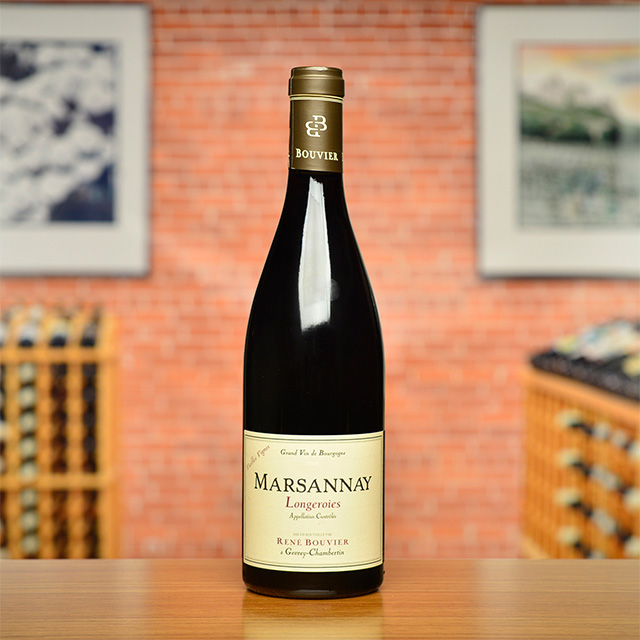
If a handful of Côte d’Or villages, like Volnay, Meursault, and Gevrey-Chambertin, have been consistently prestigious for centuries, Marsannay lies at the other end of the spectrum. Despite having been preferred by the dukes of Bourgogne as far back as the fourteenth century, it has largely been overlooked throughout the last couple of centuries, and its reputation has been on the rise only in the past few decades with the accumulation of talented vignerons such as René Bouvier. Why did the Côte de Nuits’ northernmost appellation languish in obscurity and misunderstanding while its neighbors prospered?
The recent history begins in the nineteenth century, when Marsannay producers broke from the rest of the Côte and generally ripped out their Pinot Noir vines in favor of Gamay to satisfy the market of neighboring Dijon. After phylloxera completed the damage to Marsannay’s Pinot Noir production, Joseph Clair replanted the grape and, in 1919, made a Pinot Noir rosé, launching Marsannay’s legacy as Burgundy’s leading source of serious and delicious pink wine. Nearly five decades later, in 1965, wines from this commune were finally allowed to bear labels stating “Bourgogne Rouge de Marsannay” and “Bourgogne Rosé de Marsannay.” In 1987, Marsannay was granted AOC status, placing it in the same hierarchy as village-level Gevrey-Chambertin and Volnay. Since then, ambitious Marsannay producers have bottled their wines by lieu-dit, highlighting notable parcels. Today, many Burgundians believe that conferral of premier cru status to the best sites is imminent. If this happens, the sloping vineyard Les Longeroies will be among the first to be officially elevated.
Arguably René’s most over-delivering wine—and coming from his oldest vines—the Longeroies rouge showcases notes of black cherries, black tea, and baking spices. It stands among our most versatile red Burgundies, regardless of price.
—Tom Wolf
| Wine Type: | red |
| Vintage: | 2023 |
| Bottle Size: | 750mL |
| Blend: | Pinot Noir |
| Appellation: | Marsannay |
| Country: | France |
| Region: | Burgundy |
| Producer: | René Bouvier |
| Vineyard: | 50 years, 1.82 ha |
| Soil: | Calcareous Slopes |
| Aging: | Aged in barrel for 12-16 months, 30% new oak |
| Farming: | Lutte Raisonnée |
| Alcohol: | 13% |
More from this Producer or Region

2022 Marsannay Blanc “Clos du Roy”
France | Burgundy
I find the Clos du Roy blanc to be quite versatile at my house in Meursault, especially with fowl, pork, and veal.

2023 Fixin “Crais de Chêne”
France | Burgundy
Fixin is known as the “rustic cousin” to Gevrey-Chambertin, but Bouvier’s Crais de Chêne is refined and easy to adore—it is fruit-forward, balanced, and vibrant.

2023 Chablis 1er Cru “Mont de Milieu”
France | Burgundy
Top-notch, organically farmed premier cru Chablis.

2023 Gevrey-Chambertin
France | Burgundy
The fruit quality is dark and earthbound, like eating blackberries in the shade.

2023 Marsannay Rouge “Clos du Roy”
France | Burgundy
Bouvier fashions a red that is at once serious and gay, generous and firm, bold and elegant.

2022 Marsannay Blanc “Les Longeroies”
France | Burgundy
It is pleasantly toasty and slightly nutty, evoking pretty orchard fruit and fresh citrus, with great acidity with a little grip.

2023 Chablis 1er Cru “Beauroy”
France | Burgundy
The premier cru Beauroy is a round, ample expression of Chablis from a south-facing parcel. Silky and suave on the palate, it finishes with a whisper of salinity.

2023 Bourgogne Pinot Noir
France | Burgundy
Classic Burgundian Pinot Noir aromas and flavors, and a deeply fruited and solid core.

2023 Bourgogne Côte Chalonnaise Rouge “La Digoine”
France | Burgundy
Very pure, with a beautiful noble tannin and excellent finish.

2023 Morey Saint Denis “En la Rue de Vergy”
France | Burgundy
The wine is firmly structured and robust, with dark, plump fruit that tastes fresh and utterly drinkable.


About The Producer
René Bouvier
Three generations of Bouviers have farmed vines in the Côte de Nuits since the domaine was founded in 1910 by Henri Bouvier. After forty years of growing the domaine’s reputation, his son René, for whom the domaine is named today, took over and expanded the family’s vineyard holdings. René’s son, Bernard, took over from his father in 1992.
We began our collaboration with the Bouviers nearly two decades ago, importing the wines of Bernard’s brother Régis. Following Régis’s retirement in 2019, his brother Bernard acquired his vines, bringing them into the René Bouvier fold, and allowing us to continue our long time collaboration with the family into a new chapter. This next era importing Bouvier’s top terroirs of the Côte de Nuits brings with it a focus on partial whole-cluster vinifications and organic vinegrowing, philosophies that take Bernard’s Burgundies to new heights.
About The Region
Burgundy

In eastern central France, Burgundy is nestled between the wine regions of Champagne to the north, the Jura to the east, the Loire to the west, and the Rhône to the south. This is the terroir par excellence for producing world-class Pinot Noir and Chardonnay.
The southeast-facing hillside between Dijon in the north and Maranges in the south is known as the Côte d’Or or “golden slope.” The Côte d’Or comprises two main sections, both composed of limestone and clay soils: the Côte de Nuits in the northern sector, and the Côte de Beaune in the south. Both areas produce magnificent whites and reds, although the Côte de Beaune produces more white wine and the Côte de Nuits more red.
Chablis is Burgundy’s northern outpost, known for its flinty and age-worthy Chardonnays planted in Kimmeridgian limestone on an ancient seabed. Vézelay is a smaller area south of Chablis with similar qualities, although the limestone there is not Kimmeridgian.
To the south of the Côte de Beaune, the Côte Chalonnaise extends from Chagny on its northern end, down past Chalon-sur-Saône and encompasses the appellations of Bouzeron in the north, followed by Rully, Mercurey, Givry, and Montagny.
Directly south of the Chalonnaise begins the Côte Mâconnais, which extends south past Mâcon to the hamlets of Fuissé, Vinzelles, Chaintré, and Saint-Véran. The Mâconnais is prime Chardonnay country and contains an incredible diversity of soils.
More from Burgundy or France
2019 Charmes Chambertin Grand Cru
Domaine Taupenot-Merme France | Burgundy
2022 Savigny-Lès-Beaune “Les Grands Picotins”
Domaine Pierre Guillemot France | Burgundy
2020 Meursault-Blagny 1er Cru “La Genelotte”
Comtesse de Chérisey France | Burgundy
2021 Rully Rouge 1er Cru “Les Champs Cloux”
Domaine de Villaine France | Burgundy
2022 Marsannay Blanc “Clos du Roy”
René Bouvier France | Burgundy
2022 Nuits-Saint-Georges 1er Cru “Les Vaucrains”
Domaine Robert Chevillon France | Burgundy
2022 Bourgogne Passetoutgrain
Domaine Robert Chevillon France | Burgundy
2023 Chablis 1er Cru “Vaillons”
Famille Savary France | Burgundy
2023 Chablis 1er Cru “Vau de Vey”
Roland Lavantureux France | Burgundy
2023 Bourgogne Chardonnay
Bruno Colin France | Burgundy
2023 Gevrey-Chambertin “Les Evocelles”
Domaine Lucien Boillot et Fils France | Burgundy
2023 Givry Rouge 1er Cru “Clos du Cras Long”
Domaine François Lumpp France | Burgundy
2019 Charmes Chambertin Grand Cru
Domaine Taupenot-Merme France | Burgundy
2022 Savigny-Lès-Beaune “Les Grands Picotins”
Domaine Pierre Guillemot France | Burgundy
2020 Meursault-Blagny 1er Cru “La Genelotte”
Comtesse de Chérisey France | Burgundy
2021 Rully Rouge 1er Cru “Les Champs Cloux”
Domaine de Villaine France | Burgundy
2022 Marsannay Blanc “Clos du Roy”
René Bouvier France | Burgundy
2022 Nuits-Saint-Georges 1er Cru “Les Vaucrains”
Domaine Robert Chevillon France | Burgundy
2022 Bourgogne Passetoutgrain
Domaine Robert Chevillon France | Burgundy
2023 Chablis 1er Cru “Vaillons”
Famille Savary France | Burgundy
2023 Chablis 1er Cru “Vau de Vey”
Roland Lavantureux France | Burgundy
2023 Bourgogne Chardonnay
Bruno Colin France | Burgundy
2023 Gevrey-Chambertin “Les Evocelles”
Domaine Lucien Boillot et Fils France | Burgundy
2023 Givry Rouge 1er Cru “Clos du Cras Long”
Domaine François Lumpp France | Burgundy
Kermit once said...

Kermit once said...
For the wines that I buy I insist that the winemaker leave them whole, intact. I go into the cellars now and select specific barrels or cuvées, and I request that they be bottled without stripping them with filters or other devices. This means that many of our wines will arrive with a smudge of sediment and will throw a more important deposit as time goes by, It also means the wine will taste better.